
Question 2 The Language Question AQA English Language Paper 1 (8 marks)

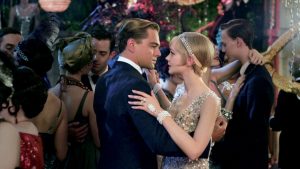
Study the extract below. The sample level 8/9 answer is shown above the Gatsby extract.
How does the writer use language here to describe the extravagance of the parties?
You could include the writer’s choice of:
- words and phrases
- language features and techniques
- sentence forms
Fitzgerald initially stirs the reader’s senses, especially the auditory and visual senses with the sound of ‘music’ mingling with the ‘blue gardens’. Instantly the language conjures up the magical, beguiling world surrounding Gatsby’s lavish lifestyle and parties. Men and girls are depicted as ‘moths’ flitting among the triple ‘whisperings and the champagne and the stars’. Here Fitzgerald has technique combined using the simile with a triple within a syndetic list to create a vivid cumulative effect of abundance. Instantly we are transported to a world of luxury.
Complex sentences juxtapose with compound sentences to create detail and provide extensive information which is typical of descriptive writing. Additionally, the extract employs vivid imagery in the form of personification as Gatsby’s ‘station wagon scampered like a brisk yellow bug’ ferrying his party guest to and from the station. This enhances and intensifies the overall mood of energy, liveliness and sheer exhilaration as he ensures his guests are personally transported swiftly. His ‘Rolls-Royce became an omnibus’ as it has transmuted into a form of public transport for his party attendees.
References to his many status symbols ‘Rolls-Royce … champagne … two moor boats’ are used as motifs to represent his opulent lifestyle and wealth.
Furthermore, numerous temporal markers ‘on week-ends … between nine in the morning and long past midnight … on Mondays … every Friday’ creates an impression of relentless activity based around Gatsby’s parties. The preparations, the actual parties and their aftermath are described in some detail, ranging from overflowing, continual food and drinks provision deliveries with ‘five crates of oranges and lemons’. Gatsby’s garden transforms into a ‘Christmas tree’ which is a striking metaphor that helps the reader to conjure up a vivid image of gaudy bright lights, opulence and over decoration.
The ‘pyramid of pulpless halves’ is a hyperbolic visual symbol of excess and extravagance which effectively illustrates the luxury and lavishness by emphasizing how much they drink, along with the reference to the machine which extracts ‘two hundred oranges in half an hour’. By including numerical references Fitzgerald indulges the reader further into an atmosphere of extravagance, heightening the feeling that they are partying in style and living within Gatsby’s lap of luxury.
Gatsby’s mansion undergoes extensive domestic preparations from the ‘eight servants’ who ‘toiled all day with mops and scrubbing brushes and hammers and garden shears, repairing the ravages of the night before’. By incorporating another syndetic list the author again exaggerates and creates a cumulative effect highlighting the intense, relentless repair efforts of his domestic staff. He also includes alliteration which adds to the exaggeration of the revelers’ ‘ravages’ to his house and garden.
The tables are resplendent with an abundance of gastronomic delights and delicacies, which not only vary in their exoticism, but in the unusual choice of adjectives and verbs used to depict their appearance and flavour as ‘garnished … spiced … crowded … bewitched … stocked’.
Overall, the extravagance of Gatsby’s parties is created through a heady mixture of the sheer volume of guests, the extensive and lavish provisions and transport laid on together with the huge amount of work before, during and after the party.
Extract from The Great Gatsby by F. Scott Fitzgerald
There was music from my neighbor’s house through the summer nights. In his blue gardens men and girls came and went like moths among the whisperings and the champagne and the stars. At high tide in the afternoon I watched his guests diving from the tower of his raft or taking the sun on the hot sand of his beach while his two motor-boats slit the waters of the Sound, drawing aquaplanes over cataracts of foam. On week-ends his Rolls-Royce became an omnibus, bearing parties to and from the city, between nine in the morning and long past midnight, while his station wagon scampered like a brisk yellow bug to meet all trains. And on Mondays eight servants including an extra gardener toiled all day with mops and scrubbing-brushes and hammers and garden-shears, repairing the ravages of the night before.
Every Friday five crates of oranges and lemons arrived from a fruiterer in New York—every Monday these same oranges and lemons left his back door in a pyramid of pulpless halves. There was a machine in the kitchen which could extract the juice of two hundred oranges in half an hour, if a little button was pressed two hundred times by a butler’s thumb.
At least once a fortnight a corps of caterers came down with several hundred feet of canvas and enough colored lights to make a Christmas tree of Gatsby’s enormous garden. On buffet tables, garnished with glistening hors-d’oeuvre, spiced baked hams crowded against salads of harlequin designs and pastry pigs and turkeys bewitched to a dark gold. In the main hall a bar with a real brass rail was set up, and stocked with gins and liquors and with cordials so long forgotten that most of his female guests were too young to know one from another.